Sources
Where every figure comes from.
A figure on this site is four things: the value, what it measures, the artifact it was read from, and the window it covers. Drop any one of the four and it is a claim, not a figure, and the build refuses to ship it. This page is the four things, explained.
- Sourced figures
- 39
- Kinds of source
- 6
- Screenshots and captures
- 13
- Discovery notes
- 12
23 with a number, the rest qualitative, across 22 records
each explained below
7 of public sites, 6 of prototypes
anonymized first moves that were written and sent
Kinds of source
Six kinds, from a dashboard export to a statement, ranked by what each can carry.
The label beside a figure names the artifact, never a quality: a dashboard export is not verified, it is a dashboard export. The weakest kind says so in its own name, and the register lets a reader filter it out.
Dashboard export
What it is
A figure read off a third-party dashboard export: Search Console, Analytics, a mail provider's deliverability report. The window it covers is printed beside it.
What it can carry
It measures what the dashboard measures, for the period shown, and nothing else. It is never a current or lifetime total, and it is never attributed to one piece of work without page-level evidence.
Running system
What it is
A system that was checked running: every route answering, a build audit passing on every deploy, a site serving.
What it can carry
It says the thing exists and works on the date checked. It says nothing about traffic or revenue unless a dashboard row says so separately.
Engineering record
What it is
Our own records of a build: a deployment log, a run summary, a repository's commit history, the schema and test suite as built.
What it can carry
It describes what was built and when. Counts of what the system processed for a client are published only where a run summary records them.
Engagement record
What it is
A contract, an invoice, a calendar of delivery sessions, or a client's own go-live notice.
What it can carry
It establishes that an engagement happened, its shape and its dates. Commercial terms stay off the page.
Document on record
What it is
A deliverable on file: a discovery and architecture document, a keyword-research file, an internal results report, a content brief.
What it can carry
It shows what was produced. Whether a client built or used what the document proposed is a separate claim, made only where a record supports it.
Operator statement
What it is
A figure the team operating a system states, with no export yet attached. Published with this label so a reader can filter it out.
What it can carry
It is the weakest kind here and it says so. When the logged window arrives, the kind changes; until then the record's withheld list names the gap.
The register
One list, every figure, with the record it belongs to.
The evidence register is the public counterpart of the internal ledger the founder keeps over the same records, restricted to what the register already publishes on a page. Weak rows stay in: a register where every property is a winner is a register nobody believes.
14
records with a dated timeline from the ledger
Milestones as precise as the record allows and never more precise: a month where a month is known, a year where only the year is.
13
query rows transcribed from Search Console
Images
7 screenshots of public surfaces, framed with what they are.
Only a surface the public can visit is ever shown: a client's own site where linking is vetted, or our own. Never a dashboard crop, never an internal system, never a credential in frame. Every file was checked for embedded metadata before it was committed.
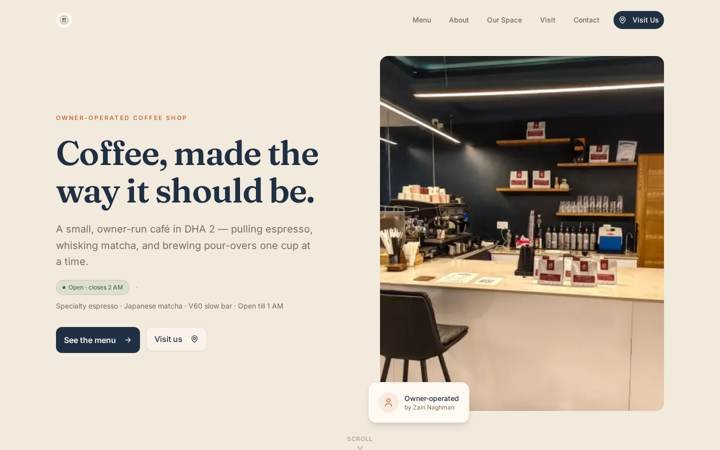
A café website the owner can update without a developer
Demos and captures
2 demos that run in your browser, 6 captures you can step through.
Prototypes are never linked at their preview address, because a preview with invented figures in it is exactly what gets screenshotted and passed off as a client dashboard. The demo is a page on this domain instead, and every figure on it says it is sample data.
Run it yourself
Step through the captures
Discovery notes
12 first moves that were written and sent, anonymized.
The one-page note and the discovery work that follows a bottleneck, sampled from proposals that actually went out. No client or prospect is named, no price or hour count is repeated, and the outcome is stated as it was: most first moves end with no build, which is the point of a first move.
A marketing diagnostic for a home-services company and its franchise arm
A channel viability study before any spend
A ninety-day paid-search trial plan for a roof-restoration company
Outreach, inbox, follow-up, voice, and billing, mapped as one system
Billing reconciliation for a small clinical practice
Lead intake, qualification, follow-up, and booking, in two phases
Guest-service automation for a hospitality operator
A spreadsheet-validation demo built before the proposal
One place to read a restaurant's point of sale, social, and web analytics
Treasury forecast automation for a logistics group
A phased build for a remote-desktop platform, after a working proof of concept
A quote packet and a consolidated technical approach for a digital publication reader
Never published
What the site withholds, and why, in the same words the build enforces.
Each of these is a rule the build checks on every deploy or the ledger records against a specific record. None of them is a preference, and none of them bends for a good number.
- A figure with no source and no period
- Deck numbers, sales-call numbers and remembered numbers stay off the page. The build fails on a list of them by name.
- A client's name without recorded permission
- Naming, linking a client's site and showing the build are three separate permissions. Only the first two are ever granted, and each is recorded before it is used.
- A dashboard crop that identifies an anonymized client
- The figures are transcribed into a query table instead, row by row, with the exact window. That is the clean derivative the ledger asks for.
- A link to a repository, a staging site or a client system
- Restricted material states its reason and offers a walkthrough. The build fails on a repository or preview host anywhere in the export.
- A client quote
- Every quote in the ledger is marked as needing permission, and none is recorded. Outcomes that need no permission are published instead.
- A prototype presented as delivered work
- Every Labs entry carries its kind on the card, every figure inside one is sample data, and nothing in Labs is counted as work.
Seeing more
Everything restricted is shown on a call, not linked on a page.
Most of the work was delivered under confidentiality or under another firm’s brand. Our own engineering is screen-shared with anyone seriously evaluating us: the code, the architecture, the tests. Client systems are walked through with the client’s permission where it is needed. That is how the site stays free of anything it should not carry.
Where to next
Have a problem in this shape?
Send a short description. We will tell you whether to automate it, build around it, staff it, or leave it alone, and which of the records above it most resembles.