Founder-direct systems work
Most of what eats your week is software nobody has built yet.
We build software, data pipelines, and automations, and we put engineers on your team when you need hands. One person scopes the work, leads the build, and answers for it.
The main figures
- projects delivered, counted once across three catalogues
- 86
Derived at build time: where 86 projects delivered, counted once across three catalogues comes from
Derived from the register, the catalogue and the portfolio at build time
Computed from the registers when the site was built, not typed by hand.
Check it- client engagements since summer 2023
- 43
Derived at build time: where 43 client engagements since summer 2023 comes from
Derived from the client records, owned ventures and internal products excluded
Computed from the registers when the site was built, not typed by hand.
Check it- countries delivered into
- 13
Engagement record: where 13 countries delivered into comes from
The evidence ledger, geographies across every record
From the contract or the engagement's paperwork.
Check it- months, the longest hourly retainer, March 2024 to May 2026
- 26
Engagement record: where 26 months, the longest hourly retainer, March 2024 to May 2026 comes from
- property audit briefed and delivered inside one business day
- 169 properties, same day
Engineering record: where 169 properties, same day property audit briefed and delivered inside one business day comes from
Delivery record, Qelv engineering record
Window 2026
From the build's own records: commits, logs, tickets.
Check it- qualified leads from our own outbound program
- 247
Document on record: where 247 qualified leads from our own outbound program comes from
Email outreach results report, Qelv internal record
Window July to October 2025
From a document held on file.
Check itStart where you are
Tick what is eating your week.
It sorts into three piles: worth building, needs a person, and leave it alone. The third pile is the point. Nothing is sent until you send it.
Your verdict appears here
Nothing selected yet. Pick as many as apply. Most companies tick three or four, and the sort says which of them is worth building first.
What we do
86 projects delivered across five practices.
ERP, CRM and POS platforms, treasury and payroll systems, voice agents and retrieval assistants, data pipelines, search programs and the engineers who staffed them. Pick the door that matches the problem.
Build
We build the software.
An operating system for the business: orders, stock, dispatch and invoicing as one system rather than four. A CRM or portal shaped around how this company actually sells, not around a template.
Automate
We make the repeat work run by itself.
A voice or chat agent that answers, qualifies, books, and writes the outcome back into the business system. Document intake that reads, classifies and files what arrives, at volume.
Data
We get you the data, clean, on a schedule.
Competitor pricing collected continuously, on a high-volume system that stays reachable against sources built to block it. Product data collected, normalized, and synced to your store on a schedule.
Growth
We build the system that finds you customers.
Local search demand turned into a working ordering path. Tracking that shows which channel a customer actually came from.
Talent
We put engineers on your team.
An agency's overflow sprint delivered white-label, on their stack. Senior hands added to a product team for a defined push.
Selected work
Systems that are running, with the source beside the number.
A high-volume hotel pricing-data system
169 properties, same day
a property data audit briefed and delivered inside one business day
Turning local search demand into a usable three-location ordering path
6.37K clicks / 174K impressions
3.7% CTR, average position 14.7
Read the case study
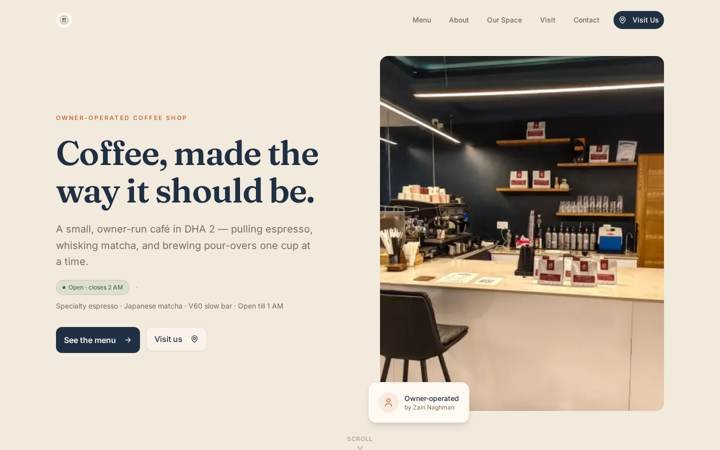
A café website the owner can update without a developer
Production site live with menu, visit, and FAQ content
Read the case study
Search windows on record
507K search impressions
Click Computer. Recorded during an email and paid-media engagement.
6.37K clicks / 174K impressions
Fish Frenzy.
How it goes
4 steps. Every one of them optional.
Nothing is bundled into a retainer. Each step is priced on its own, and most enquiries stop at the first one with a written answer.
Step 1: Send the bottleneck
Describe what is being copied, chased, rebuilt, or checked by hand. No call, no form maze.
- A read from the person who would build it
- A one-page first move if it is a fit
- A straight “leave this alone” if it is not
Step 2: Scoping call, only if you want one
Thirty minutes to pressure-test the first move and agree what success is measured on.
- The KPI the work will be judged on
- A fixed price and a delivery window
- What we are deliberately not doing
Step 3: Fixed-price build
The smallest useful system, shipped. Price agreed before work starts and it does not move.
- A working system in your accounts and repository
- Handover documentation
- The measure from step 2, reported against
Step 4: Run it, or take it and go
Where continuity matters, we operate it. Where it does not, you own it outright and we are done.
- Monitoring and an owner for the thing that breaks
- A monthly care plan, only where a running system needs one
- No lock-in: it runs without us either way
What step one returns: 10 free first steps.
Each is a document or a sample with a named input and a named output, not a discovery call in a different hat.
5 outcomes we agree to be judged on.
- A working system in weeks, not a document
- Measured on Time from first note to something in production use
- The repeat work stops needing a person
- Measured on Hours a week returned, and cost per processed item
- Data that keeps arriving after launch
- Measured on Feed uptime, freshness, and manual interventions per week
- Founder-direct technical judgment
- Measured on Rework, and decisions that do not need a second meeting
- You own everything
- Measured on Whether anything breaks when we walk away
Before you write
The questions that come up every time.
Something not covered here? Ask it in the form and it gets a straight answer from the person who would do the work.
What does a build cost?
Most first builds are fixed-price in the low thousands, delivered in one to three weeks. Larger builds (operational platforms, prototypes, client portals) run higher, and ongoing operating support is a separate monthly figure. Every price is built the same way: the hours the work takes, the tools it runs on, and a share of company cost. It is agreed before work starts and does not move. The pricing page shows the full arithmetic.
Why are your rates lower than a local hire?
Structure, not corner-cutting. We are a US company with a distributed team and no office, sales floor, or delivery-manager tier, so the overhead built into an hour is smaller. What does not change is the standard: work is reviewed, tested, and documented, it lands in your repository, and the engineer who scoped it is the one who builds it.
How is this different from hiring someone?
It is usually not either/or. A job posting is a list of tasks, and some of those tasks are rules rather than judgment; those are software. Automating them costs less than the first month of the salary and does not resign. The seat still gets filled; it just starts further along, doing the part that needs a person.
Do we have to commit to a retainer?
No. Send the bottleneck, take the one-page first move, and stop there if you want. A build is a build. Monthly support exists only where a running system needs an owner, and it can be cancelled.
Where to next
Send the bottleneck. Get a written answer.
A few sentences on what is still being done by hand is enough. We tell you whether to automate it, build around it, staff it, or leave it alone.