Custom softwareWholesale and manufacturing
An order desk built twice, from both sides of the trade
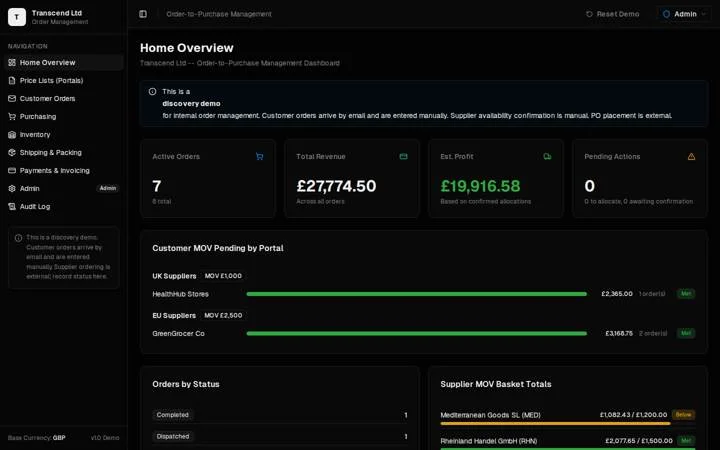
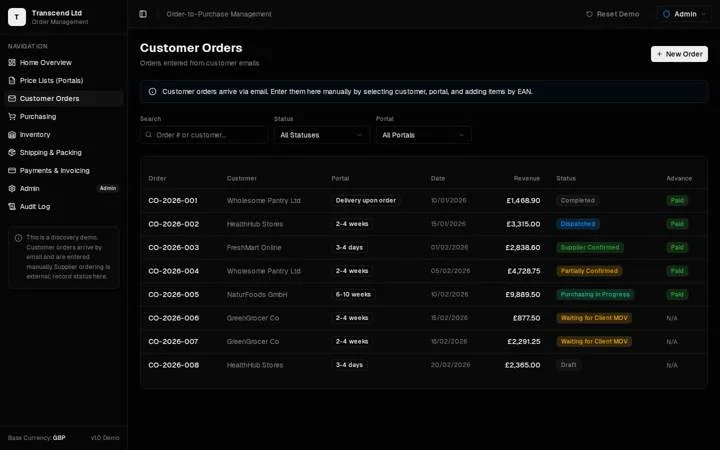
Transcend Ltd, a UK wholesaler in perfumes and FMCG
13 implementation items assigned after the demo-kickoff review
For software teams
Each round is a working version at a price agreed before it starts. Test it with users, then decide the next round.
This is you if
What hurts
The cost is rarely the code. It is the size of each bet and how long you wait to learn from it.
One answer bought with the time 3 tries needed.
A pivot priced as a new project, each time.
A quarter spent on specifications that describe the product instead of running it.
Weeks per seat, in sequence, while the team covers both gaps at once.
What the money buys
A round is the smallest version that can answer one question. You pay for a round, not for a roadmap.
Decide the round
Who it is for and the smallest version worth testing, written down before any code.
$500 to $3K, usually fixed-price
Get a quote for thisShip a round
A working version on real data. Run it again for the next direction, at the same shelf price.
Change between rounds
Small changes by the hour while users test, invoiced weekly. Stop when the answer is in.
$10 to $40 an hour, by seniority · weekly invoicing
Get a quote for thisHold the direction
A named developer in your standups once a round has shown where to go.
$1.6K to $4.8K a month, part time to full time
Get a quote for thisBuild the release
Accounts, billing, the core workflow and an admin, for the direction that earned it.
$3K to $15K, usually fixed-price
Get a quote for thisWhat several rounds come to, at the shelf price of the two-week prototype
Proof
An order desk built twice for one wholesaler, a cafe's operations system, and a prototype an IT firm saw run and then funded.
Custom softwareWholesale and manufacturing
Transcend Ltd, a UK wholesaler in perfumes and FMCG
13 implementation items assigned after the demo-kickoff review
Custom softwareHospitality and restaurants
Our own product, built for the cafe we own in Islamabad
A point of sale with a barista queue, void reversals that leave a trail, stock tied to recipes, shifts and loyalty, on one PostgreSQL schema.
Custom softwareSoftware and IT services
A prototype we built for Selenium Group, an IT-services firm in Toronto
A React portal, a .NET and PowerShell Windows agent and an ASP.NET Core relay for managing remote PCs, which the firm funded to continue and then took through a design phase.
Free first
Scope the round yourself, or send it and get the plan back.
Free
What to build or replace first, what to leave alone, and in what order.
You send: The system you are outgrowing, or the process nobody has a system for. A few sentences, or a screenshot of the spreadsheet.
Tutorial
Answer eight short questions and get a one-page brief you can send as it is.
Every question a project needs answered before it is priced, from who signs off to which data sources it reads.
How Faizan scopes a project: the 10 questions he asks, the red flags, when the answer is to leave it alone, and a sample one-page plan.
The 12 sections every Qelv proposal and statement of work follows, with what goes in each. No client data.
Your brief
Pick an answer to each. We turn them into the brief the form opens with, and you edit it before sending.
No budget yet
A solid product, a pipeline to build and no budget for the first push? Write to us anyway.
We go as far as we can pro bono: free scoping and a discovery workshop. We lay out the sales channels open to you, test each one small and validate the one that fits where you are today.
Ask for a discovery workshopTell us what you sell and who buys it. Faizan reads it himself.
Questions
A two-week prototype is $2.5K to $5K, usually fixed-price. Scoping a round first is $500 to $3K. Each round is priced before it starts.
You do. Every round lands in your repository, so a round with us never blocks the next one, with us or with anyone else.
We talk it through and agree any change with you before that work starts. A new direction is its own round, with its own price.
Yes. A developer by the hour is $10 to $40 an hour, by seniority, invoiced weekly. A dedicated developer is $1.6K to $4.8K a month, part time to full time.
Also
Next step
Describe the product and the question the next version has to answer. The plan is free.
Next from here
Off the main path